Jack Broadbent on the Road Again Guitar Tuning
"On the street, it'due south more of a jam," says Broadbent. "You tin can rattle around the aforementioned melody all day, as long as there's new people coming by. That's where I got my x,000 hours in."
The British busker extraordinaire isn't opening for the likes of Skynyrd, Frampton, and Ron Woods but considering he rips fiery solos with a alcohol decanter.
The term "busking" showtime popped up in the English language in Bang-up Britain around the middle of the 19th century. It derives from the Castilian buscar, pregnant "to seek," and refers to outdoor performers playing for tips from passersby. In America, we telephone call them street musicians.
Jack Broadbent, who popped up in Great United kingdom of great britain and northern ireland in the latter office of the 20th century, spent much of his youth busking on the streets of various countries. The seeker appellation fits him nicely as well—from his globe traveling to his evolution as a guitarist to his perception of the COVID-19 quarantining in effect at the time of this interview as an assist rather than a hindrance to his quest. "I find myself sitting with a guitar in my paw, bursting with ideas," he says. "I feel happy I've got time to experiment more to see what I want to do."
Born in Lincolnshire, England, Broadbent grew up with plenty of guitars and music in the house. His begetter, Mickey Broadbent, played bass in the successful ability-pop band Bram Tchaikovsky ("Girl of My Dreams"). "At present he plays with me," Jack says. "We exit as a duo quite ofttimes. Nosotros were just supporting Ronnie Forest on tour in the U.One thousand."
Though now known equally an exciting blues guitarist, Broadbent initially develop his playing as a means to write songs. "As I gravitated to styles like dejection and jazz, I had to pick up more skills," he explains. "Simply it was all self-taught, through songwriting."
Although information technology was Broadbent's flashy boogie playing—including his preference for playing slide with a worn whiskey flask—that excited street audiences for many years, when he moved into clubs and festivals he found a welcoming domicile for his songwriting. Some songs on his new album, Moonshine Blue, recall '60s British blues bands similar Fleetwood Mac and Savoy Brown, who helped reintroduce Americans to the heritage they had neglected. On other tunes, Broadbent mines the singer-songwriter tradition that burgeoned in the hills around 1970s Los Angeles. Somehow, in the blend of his deft-but-easygoing guitar work and warm, dusty singing, he makes it all work together every bit a single musical voice.
The story of this seeker's journey toward musical integration provides an interesting dissimilarity to some of today's YouTube-to-stardom career trajectories. As storytelling is office of the troubadour's trade, Broadbent was happy to hold along.
How did yous become into blues?
After my begetter had been playing stone 'due north' coil for years, he moved dorsum to Lincolnshire and ended up playing in local bands. Effectually the fourth dimension I was born, in 1988, there were a lot of R&B and blues bands doing the circuit, so I was brought up on R&B and nifty local blues. That music was in my caput from twenty-four hours one, but I didn't really include blues in my repertoire until many years afterwards. I played more folk music and stone until I was way into my 20s.
A number of your tunes feature boogie rhythms, which I assume comes from John Lee Hooker.
Absolutely. I am always referencing people like Peter Green and John Lee Hooker.
Did you play in bands with your father or more with people your own historic period?
I was writing more than from a solo perspective. Anything I would write, me and my dad would play together, just for the enjoyment of it. I steered away from the band thing because I didn't want to sound similar everybody else.
Your 2013 album Public Announcement sounds like a band recording.
It'southward more of a band sound, simply it wasn't a band. That was me playing all the instruments. I had a house up in the Lake Commune, and a digital iv-track machine. It was a project that came out of experimentation.
That'due south the beauty of busking: It goes with y'all wherever you lot go.
Y'all play drums as well as guitar?
I play everything. When I did play in bands with my begetter and other people, it was quite often as a drummer or bass player. Now that I'k established as a guitar player, I never go a chance to hit the pots and pans, which is a bit of a shame.
When did you start busking?
Around age 21.
Did yous move to London to practice it?
I predominantly honed the skill in London, then used to become over to Europe—places similar Amsterdam, Berlin, or France. That's the dazzler of busking: Information technology goes with you lot wherever you go.
Did you prefer busking to joining or putting together a band?
It certainly makes more money. I was doing it to support a lifestyle of writing songs. I was a busker past day and then gigging in clubs past dark. Over the years, the stuff I was playing on the street started to infiltrate my club set. Before that information technology was more on the vocalist-songwriter side. Now, I like to think I pull information technology all together under the guise of roots music.
How did the repertoire differ from the streets to the clubs?
On the street, y'all take a lot more than freedom. You lot oasis't got a time schedule to adhere to. I was playing more than finished songs at shows, but then I slowly started to realize I could integrate a little more freestyle playing. I started to bring my slide guitar more onstage rather than just using information technology as a busking entity.
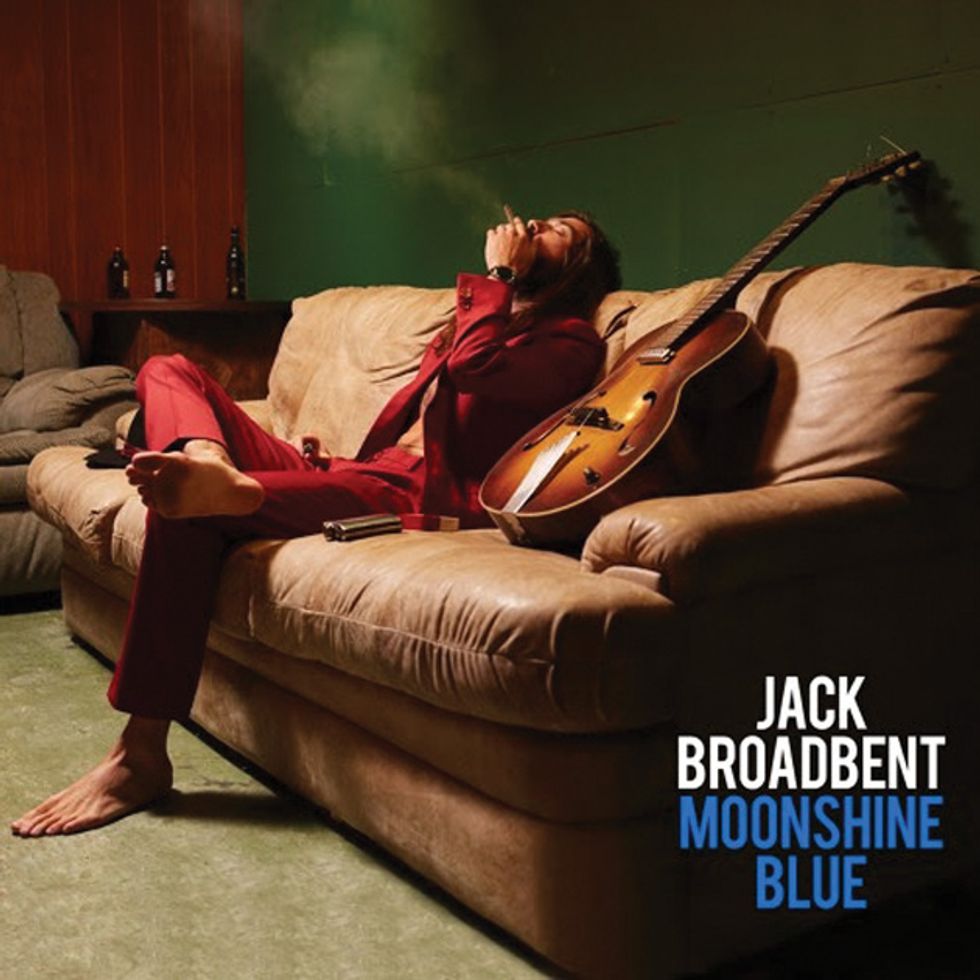
TIDBIT: For his fourth studio anthology, Broadbent cut his guitar tracks while being accompanied by his begetter, Mickey, on bass, and the residuum of the instruments were recorded later.
What did busking teach you that translates to indoor gigs and festivals?
It taught me communication between the performer and audience—virtually breaking down the rubbish barrier of "This is a performance—yous watch me. I don't talk to yous. Y'all don't talk to me." When busking you tin stop any time, accept a chat, do any yous desire to practise.
What doesn't translate?
You can't take a smoke break in between songs [laughs]. On the street, it's more of a jam. You tin can rattle effectually the aforementioned tune all day, as long as there's new people coming past. That's where I got my 10,000 hours in. If yous practice something long enough, you get a proficient feel for it. For me, swinging a blues groove in front of people for a couple of hours every 24-hour interval without fail might not have been a formal lesson, only it all sank in.
Is that how 2103'southward The Busking CD was born?
That was to sell whilst busking.
Where did you record it?
In my apartment in London.
You've developed a way that sounds like you, even every bit you lot shift from a apartment-out boogie to a sensitive vocalizer-songwriter number. Is it the distinctive audio of your voice that makes it all piece of work?
I suppose that'southward the factor that keeps everything together. Like Neil Young and Radiohead, I dearest to play different styles of music and guitar. I wouldn't e'er desire to experience I was pigeonholing myself. The death of inventiveness would be to say, "from at present on, I simply play blues, or folk."
Other than the obvious spectacle factor, what inspired you to use a flask as a lap slide?
It was the closest thing to me at the time, I call up.
So, you lot fell into information technology from taking a nip before playing?
Playing on the cold streets of England, it'due south nice to have some good company in your pocket.
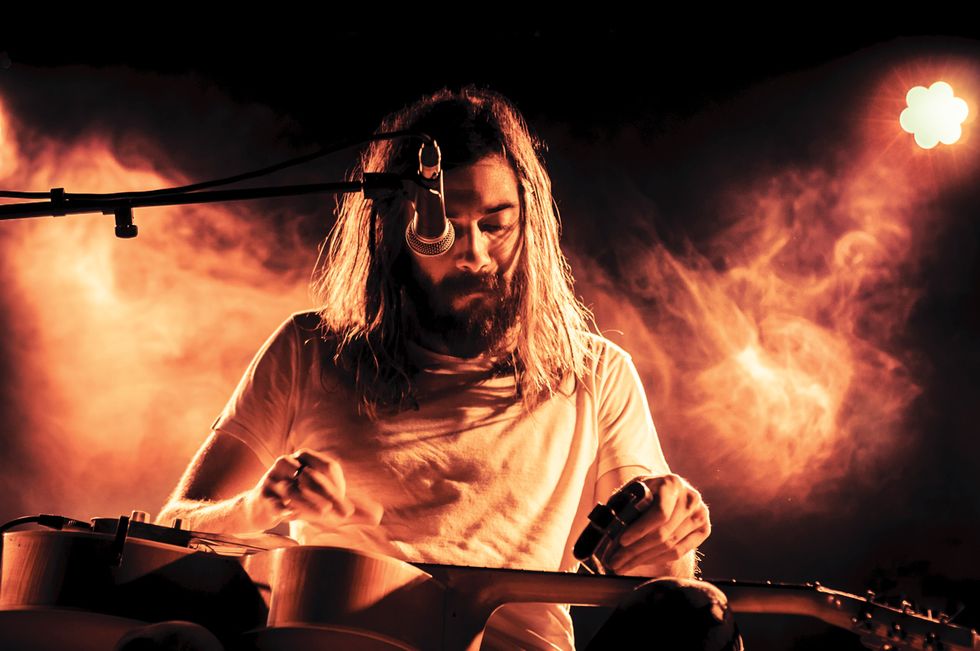
Riding the frets with a well-worn steel whiskey flask, Broadbent flogs his open-D-tuned Hofner Senator. About his choice of slide, Broadbent says, "Playing on the cold streets of England, it'southward overnice to accept some practiced visitor in your pocket." Photo by Justin Brown
What are those distinctive-looking guitars yous're using?
They are both 1965 Hofners. One is a Congress model, the other's a Senator. The Senator is the one I use for slide guitar. I found them to be very robust. I like the audio and look of them. I'm currently endorsed by Hofner, but I choose to play the older instruments for their tone.
What gauge strings do yous use?
I use heavy strings, like .013s on the Senator for slide guitar, and .012s on the Congress. I unremarkably become for D'Addario.
Practise you lot utilize the same tunings for lap and standard playing?
Generally, I like to play in D, because information technology suits where my voice sits, just when you're using open up tunings, the simple application of a capo ways you lot've got quite a lot of liberty to play in other keys.
Is it total open D—with the tertiary cord tuned to F#—or some variation on that?
Open-D [D–A–D–F#–A–D] is the staple, yep, but I've got a couple of hybrids for a few tunes. I like to proceed those a trivial closer to my breast.
What amp do you use when playing on the street?
I haven't played on the street for about six years now, but when I did I always used a Roland Cube Street. I still do. If it ain't bankrupt, don't ready it. Sometimes, say for recording, I'll flirt with other things, just because I've managed to go a sound together like that, I attempt not to steer likewise far away from it. I similar that scratchy audio.
Are yous using that now at festivals and clubs?
All the same using the shanty busking equipment, yeah. I mostly DI the amplifier, so I'm using it as a glorified distortion pedal and reverb unit.
In one video, it looked like y'all were sitting on your amp.
I all the same exercise that as homage to where it all kicked off from. It keeps me subconsciously grounded. I run the amp off six AA batteries, which is pretty crazy. When I was opening for Lynyrd Skynyrd, Peter Frampton, and Ronnie Wood, the audio engineers were ever going, "You lot're going to apply batteries?" I'chiliad like, "Yep." Sometimes you get a fiddling actress saturation and thickness of tone when the batteries start to run down a niggling.
I run the [Roland Cube Street] amp off 6 AA batteries, which is pretty crazy. When I was opening for Lynyrd Skynyrd, Peter Frampton, and Ronnie Wood, the sound engineers were ever going, "You're going to use batteries?" I'm like, "Yep."
On Moonshine Blue, is that just you or are yous playing with other musicians?
The new record was a piffling different. Lynyrd Skynyrd's current piano player, Peter Keys, is playing keys on it. I recorded it at his studio in Nashville. My father plays bass, and it'due south me playing percussion. Bruce Cameron, who produced it with me, plays some keyboards every bit well, and a guy chosen Mickey Gutierrez plays a saxophone solo on one of the songs.
A lot of times when people usually play solo, information technology tin be hard for them to sync with other musicians.
I played alive in the room with my father, and so added the percussion later. All the other pieces came in around that.
The album sounds very intimate.
Nosotros close-miked the vocal and the guitars, particularly on the softer material, to go that proximity.
Were y'all using the Roland amp in the studio?
I definitely used it for the slide guitar parts. This time I wanted the slide guitar to be more an accompanying musical instrument, rather than ever the lead part, so I recorded the bones of the songs on acoustic guitar. I then added the slide around it in the same manner I was adding keyboards, merely to support the cloth.
Were you lot using the Hofner Congress for the acoustic parts?
For some songs I used my Hofner. For others, I used a Gibson L-00, which is like a reissue of the LG-two. I now actually accept a 1949 Gibson LG-2 that I just picked upwards, which will be definitely featured on the next tape. It has such a beautiful, clean acoustic tone.
How was the high sustained note at the end of "Moonshine Blue" produced?
I used an EBow and slide.
It sounds similar different guitars were used for the rhythm and slide parts.
It was the Hofner Congress, my acoustic guitar for the rhythm part, so the slide solo was the Senator with amplification.

Guitars
1965 Hofner Congress
1965 Hofner Senator
1949 Gibson LG-2
Gibson 50-00
Gibson Tune Maker
Amps & Effects
Roland Cube Street
Strings & Slide
D'Addario .012 and .013 sets
Half-pint whiskey flask
How did you get the distortion on the slide guitar on "The Lucky Ones"?
That is from the Cube.
There's a filtered background audio on the intro to "Wishing Well." Is that a keyboard?
That is a reverse guitar. I took a section of the guitar and stuck it in backwards … just classic messing-around studio stuff.
At that place'south also a distorted guitar behind the acoustic, and a solo that sounds like multiple guitars at the same fourth dimension.
I used acoustic guitar as the basis, and then used a Gibson Melody Maker to double up the rhythm function and for the solos. I tried to weave the solos off each other. I split them left and correct, and let them fight. I wanted them to get off like fireworks. I was recording with a member of Lynyrd Skynyrd, so there was definitely an element of sneaking in that double-threat guitar solo thing.
"The Other Side" has an interesting chord progression—Eastward minor to C modest. What inspired that?
I was experimenting with tunings. That song's played in a drib-C tuning—essentially open-G just with a low C in the bass. There was something about being able to anchor back to that C that felt nice.
Tunes similar "This evening" and "The Lucky Ones" take a pop experience. Where do those sorts of influences come from?
I dearest bands like Steely Dan, Piffling Feat, and the Doobie Brothers. I was listening to all that stuff when I was about 16, so I suppose any hint of a popular music aspect was coming from my love of bands like that. I've never been shy of a hook.
There is a very '70s Laurel Coulee audio to some of the songs on the album.
That comes from my love of the Band, Crosby, Stills & Nash, and Joni Mitchell. All the good stuff.
Was the thin production influenced by the fact that you knew you lot'd be going out and playing it solo?
Yeah. I tin can play the whole record solo acoustic, because all the songs were written solo acoustic. In the studio, it's more virtually colour and to exist able to hear the potential of extra parts.
What's the programme from hither?
I but came off tour all over united states, from Alaska to Florida, from Seattle to L.A., and back upwards to Chicago. Now, I'one thousand in [coronavirus-mandated] isolation. The adjacent record is written. I was supposed to be going into the studio in the side by side couple of weeks. Plainly, due to the electric current situation, that's having to be pushed forrard. It means I've got more time at present to refine what I was already working on.
Where are you going to record the new anthology?
I similar to record at dwelling house studios in nice locations, where I take freedom to not worry too much about how much time I accept. The idea was to go and do it in the South of France at my friend'south place. Me and my producer, Bruce Cameron, were going to take some gear downwards somewhere vibey, old-Rolling-Stones-style. I like to work at dark and not a lot of professional studios similar you staying up until 5 in the morning.
Not anymore, anyhow.
Well, exactly, and you can't fifty-fifty have a spliff while you're working.
Flask in hand, Jack Broadbent lays into his slide, lap-style, and then flips to conventional roundneck fingerpicking during this Feb 2020 mini-concert at the Paste Magazine studio in New York Metropolis.
Source: https://www.premierguitar.com/artists/jack-broadbent-more-than-whiskey-flask-flash
0 Response to "Jack Broadbent on the Road Again Guitar Tuning"
Post a Comment